How to write a follow-up email after a meeting (templates)


In this article
Write a follow up email after meeting by stating the outcome, confirming decisions, and listing each next step with an owner and an agreed deadline. Keep unresolved questions separate from commitments, then end with one clear request. The templates below show how to do that without sending everyone a transcript.
- A follow up email after meeting should confirm decisions, action items, owners, and agreed deadlines.
- Use a meeting summary for context; use the email to make the next action clear.
- Omi turns captured conversations into transcripts, summaries, and tasks; verify commitments before sharing them.
How do you write a follow-up email after a meeting?
Start with the result, not a chronological account of the conversation. If your notes are scattered, organize them into a meeting summary before drafting the email.
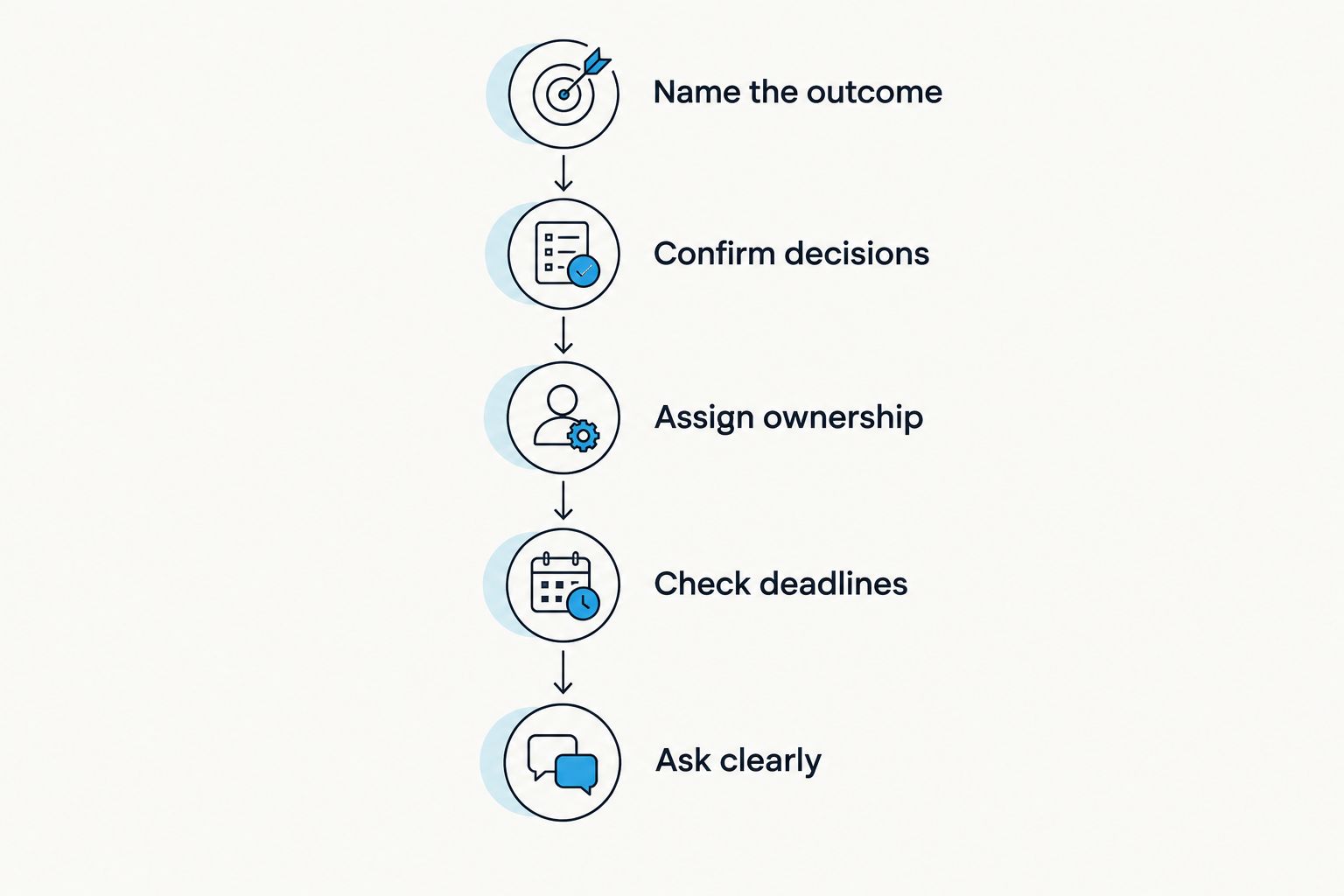
Use this sequence:
- Name the outcome. Open with what the meeting resolved, established, or left undecided.
- Confirm decisions. State what participants actually agreed to, without upgrading suggestions into commitments.
- Assign ownership. Give every action a named person responsible for completing it.
- Check deadlines. Include agreed dates. Mark an unconfirmed date as proposed rather than presenting it as settled.
- Ask clearly. End with the response you need: approval, a document, a correction, or a decision.
Before sending, check that someone who missed the meeting could understand the next step. That is the test. A polished recap that leaves ownership unclear still needs work.
Why this matters
A follow-up email becomes a written reference for what happens next. It should separate the decision from the discussion that produced it. Otherwise, a tentative idea can read like an approved plan.
Your email should reduce ambiguity, not preserve every sentence. Include the reasoning when it changes how someone should act; leave out conversational detours that do not affect the outcome.
For example, a team might discuss several launch dates but agree only to check staffing. The follow-up should assign the staffing check. It should not announce a launch date that nobody approved.
Which follow-up template should you use?
Choose the format by the response you need, not by how impressive the email sounds. A client scope confirmation and a networking thank-you have different jobs.
| Format | Best for | Strength | Limitation |
|---|---|---|---|
| Client meeting | Confirming scope and responsibilities | Separates agreed work from additional requests | Needs careful wording around approvals |
| Internal project meeting | Coordinating shared work | Makes owners and blockers visible | Becomes cluttered if it includes every discussion point |
| Sales conversation | Confirming needs and the next evaluation step | Keeps the buyer's priorities explicit | Feels pushy if it assumes interest or approval |
| One-on-one meeting | Confirming support and personal commitments | Connects discussion to a specific action | Requires care with sensitive feedback |
| Networking conversation | Continuing a useful introduction | Keeps the request narrow and personal | Does not replace a project handoff |
The examples below are fictional drafts, not records of real meetings. Replace the names, dates, and commitments with facts from your own conversation before sending.
Client meeting: confirm scope before work starts
Best for: a client conversation that produces a deliverable or approval step. Lead with the agreed work, then identify anything still waiting for confirmation.
Subject: Website messaging meeting — scope and next steps
Hi Maya,
Thanks for meeting on September 24, 2026. We agreed to revise the homepage messaging around the customer problems discussed, while keeping the existing page structure.
Next steps:
- Alex will send the revised draft by September 29, 2026.
- Maya will provide the approved product terminology before drafting begins.
- Additional page changes remain outside this draft until we confirm their scope.
Please reply with the approved terminology and flag any difference between this recap and your understanding.
Thanks, Alex
This format makes the boundary visible without turning the email into a contract. Its weakness is that a recap alone does not establish approval: if your process requires formal authorization, request that through the appropriate channel.
Internal project meeting: make ownership visible
Best for: a team meeting where several people leave with connected tasks. Put dependencies next to the work they affect so the handoff is understandable.
Subject: Onboarding project — decisions, owners, and blocker
Hi team,
Following our September 24, 2026 meeting, we'll keep the current onboarding sequence and revise the welcome instructions before changing the wider flow.
Actions:
- Priya will draft the revised instructions.
- Ben will review the draft for support accuracy after Priya shares it.
- Sam will confirm the review deadline with both owners.
Open blocker: the final account setup wording still needs confirmation from the product team.
Priya and Ben, please confirm that this handoff matches your understanding. Sam will circulate the agreed dates afterward.
Thanks, Jordan
Notice what this draft does not do: invent deadlines to make the recap look finished. An unconfirmed deadline belongs under an open question, not under an agreed commitment.
Sales conversation: confirm the buyer's next step
Best for: a sales discussion with a specific evaluation question. Reflect the buyer's stated need and confirm the next interaction without treating curiosity as a purchase decision.
Subject: Reporting workflow discussion — next evaluation step
Hi Daniel,
Thanks for the conversation on September 25, 2026. You described a need to reduce manual handoffs between account reviews and your reporting process.
The next step we discussed is a session focused on that workflow, rather than a general product overview.
I'll send an outline covering the current handoff, the information your team needs, and the questions still open. You'll confirm who should join from operations.
Please send the attendee names and any workflow details you want included. We can then confirm the session time.
Best, Taylor
The advantage is precision: the email records a need and an agreed action. The limitation is equally important. If the buyer did not agree to another session, replace that claim with an invitation and let the buyer decide.
One-on-one meeting: confirm support without oversharing
Best for: a manager or colleague confirming personal commitments. Keep the message focused on agreed support, responsibilities, and follow-through.
Subject: One-on-one recap — priorities and support
Hi Morgan,
Following our September 25, 2026 conversation, your immediate priority is finishing the customer handoff documentation before taking on the reporting cleanup.
I'll ask the project lead to clarify which handoff questions need your input. You'll flag any missing information that prevents you from finishing the draft.
We left the reporting cleanup schedule open until that dependency is resolved.
Please let me know if I've missed a commitment or misunderstood the priority. We can revisit the remaining workload at our next check-in.
Thanks, Casey
A written recap makes support commitments explicit, but it is not a reason to circulate private feedback. Check recipients carefully and leave out personal details that do not belong in a shared record.
Networking conversation: make a small, relevant ask
Best for: continuing a conversation without implying an obligation. Mention the actual topic and ask for something the recipient can answer directly.
Subject: Following up on our service handoff conversation
Hi Jamie,
It was good speaking with you on September 28, 2026. Your description of the handoff between field visits and office coordination gave me a useful question to explore with my own team.
You mentioned a checklist your team uses to keep that handoff consistent. If it is shareable, would you send the version you referenced?
No need to include internal customer details. I'm interested in the structure rather than the underlying records.
Thanks again, Riley
This approach keeps the request specific. Its limit is that a networking conversation does not create a commitment to share documents, make introductions, or schedule another meeting.
Why the right follow-up email varies
Use the meeting's actual outcome to decide what belongs in the message. These factors change the structure:
- Decision status: An approved decision needs confirmation; an unresolved choice needs a question.
- Audience: Attendees need a concise record, while someone joining later needs enough context to act.
- Ownership: Shared discussion does not identify who will complete the work. Name the responsible person.
- Dependencies: Explain what must happen before another task can begin.
- Sensitivity: Personal feedback, customer information, and confidential material need deliberate recipient choices.
- Requested response: A request for approval needs different wording from a simple informational recap.
Do not add sections just to fill a template. If there were no decisions, say what remains open and identify the next step toward resolving it.
How soon should you send a meeting follow-up email?
Send the follow-up after checking the record and before someone needs to act on it. If you agreed to a delivery time during the meeting, use that commitment rather than an arbitrary etiquette rule.
When a detail remains uncertain, send the confirmed points and label the uncertainty. Waiting for a perfect recap should not prevent you from communicating a blocker that already affects the work.
What should the subject line say?
Use the meeting topic plus the purpose of the email. Subjects such as Onboarding review — decisions and next steps or Proposal discussion — approval needed tell the reader what the message requires.
Avoid calling something approved, final, or urgent unless that description is accurate. A subject line should summarize the message, not escalate it.
How do you follow up when nobody replies?
Reply in the original thread and repeat the unanswered request. Make it easy to identify the decision needed rather than asking whether the recipient saw your email.
For example: Please confirm whether the revised scope is approved. Drafting remains on hold until that decision is confirmed. If you need input from someone else, let me know who should join the thread.
Turn the conversation into a draft, not an unchecked promise
Omi is best for professionals who want captured conversations turned into searchable notes and tasks. The wearable and companion app produce transcripts, summaries, action items, and memories that give you a record to review before writing.
Use Omi meeting notes to check names, decisions, and stated next steps. Then write the email for its recipients, not as a copy of everything captured.
The benefit of Omi meeting notes is having transcripts, summaries, and tasks available for review. The limit is that generated output still needs checking: a proposed deadline is not an agreed deadline, and a mentioned task is not necessarily an accepted assignment.
Before recording, explain the capture process to participants. Consent rules vary by location; check local law and your organization's policies.
Check the email before you send it
Read the draft as the person expected to act. Can you identify the task without rereading the conversation?
- Use 3 bullets as a drafting limit for the most important outcomes; add detail only when action requires it.
- Name 1 accountable owner per task instead of assigning work to everyone.
- End with 1 primary request so the response needed is unmistakable.
- Check dates against the meeting record, including the year when timing could be ambiguous.
- Remove commitments nobody accepted and attachments the recipients do not need.
These are editing constraints, not measured performance benchmarks. Break them when the work requires it, but keep the same standard: every line should help someone understand or act.
FAQ
What's the best way to start a follow-up email after a meeting?
Start with the meeting's outcome, then confirm the next action. A brief thank-you is fine, but it should not delay the substance.
How long should a meeting follow-up email be?
Keep it long enough to communicate decisions, owners, deadlines, and open questions without retelling the discussion. Put supporting detail in a separate record when it distracts from the request.
Should I attach the full meeting transcript?
Attach a transcript only when recipients need it and sharing it is appropriate. A concise recap is not permission to distribute everything participants said.
What if we didn't agree on a deadline?
Label the deadline as proposed or ask the owner to confirm it. Do not turn your preferred date into a commitment on someone else's behalf.
How do I write a follow-up email without sounding pushy?
State the agreed next step and ask directly for the information or decision you need. Do not imply approval, urgency, or interest that the other person did not express.
Can Omi help me prepare a meeting follow-up?
Omi provides transcripts, summaries, and action items you can review when preparing a follow-up email. Check names, ownership, and deadlines before sending the draft.
Should I send a follow-up if the meeting ended without a decision?
Yes, when the unresolved issue needs a next step. State what remains open, who will investigate it, and how the decision will be revisited.
One last thing
Write down what was not decided when it affects the work. A short line such as budget approval remains open can prevent your recap from sounding more final than the meeting actually was.
A useful follow-up does not make the conversation look tidy. It makes the next action clear.