How to take lecture notes you'll actually use


In this article
To take lecture notes you'll actually use in 2026, capture the main argument, supporting evidence, worked examples, and questions—not every sentence. After class, correct gaps and turn your headings into questions you can answer without looking. If you record the lecture, get permission first and treat the transcript as backup, not finished study notes.
- How to take lecture notes: capture ideas, preserve examples, and turn headings into practice questions.
- Cornell notes suit question-based review; outlines suit lectures with a clear hierarchy.
- Omi suits students who need searchable lecture transcripts alongside their own notes, where recording is permitted.
- Check formulas, names, and technical terms against course materials before studying from a transcript.
Why this matters in 2026
Your lecture notes need to help you answer questions, not recreate the lecture. A page of copied sentences gives you material to reread. A page organized around explanations, examples, and unresolved questions gives you something to work through.
Choose a structure before class so you aren't making formatting decisions while the instructor explains something difficult. This guide to note-taking methods compares the main formats; the workflow below shows what to put inside them.
How do you take lecture notes you'll actually use?
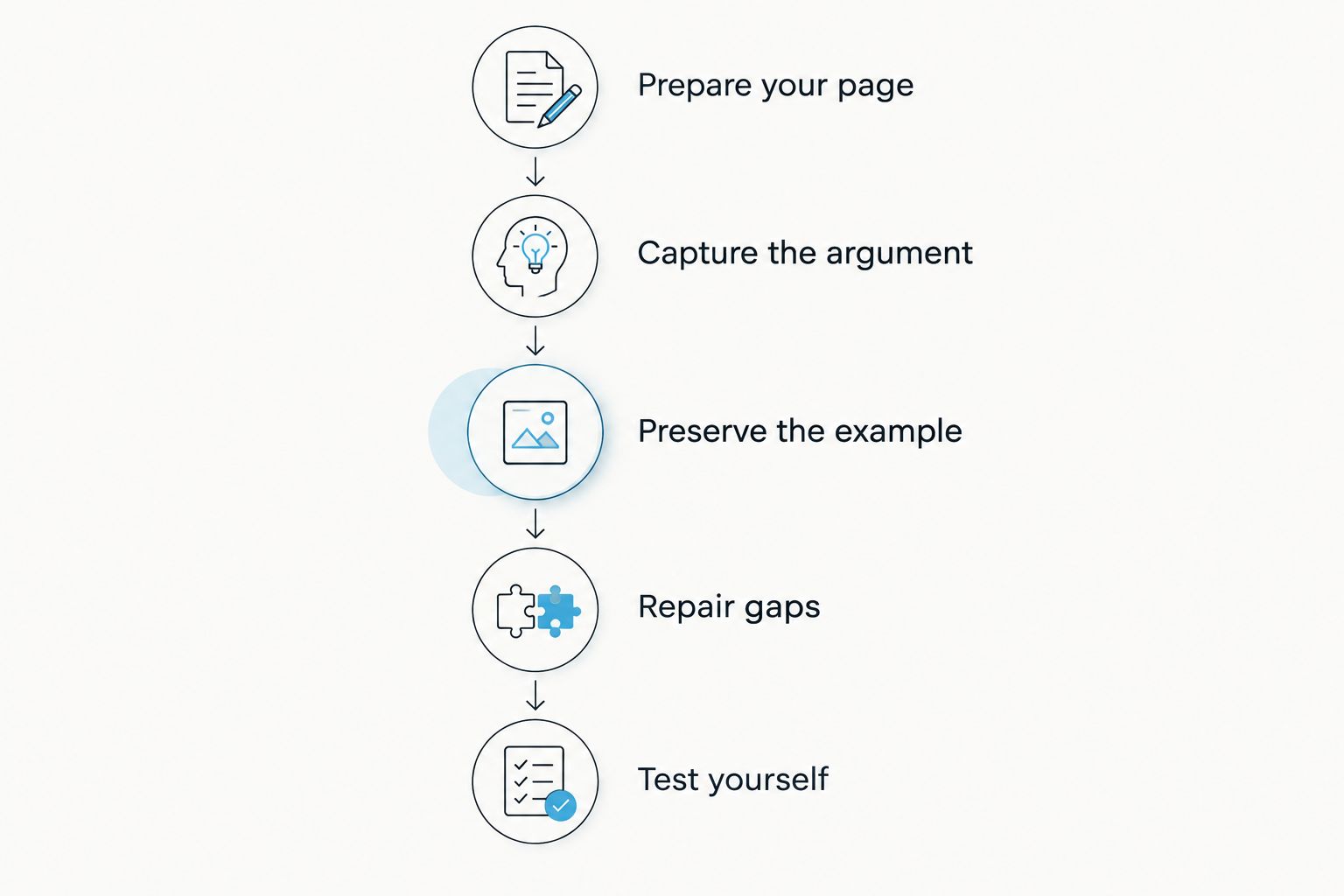
Follow this sequence: prepare a structure, capture the argument, preserve examples, repair gaps, and test yourself. Keep the original lecture material separate from your own interpretation so you can tell what the instructor said from what you inferred.
1. Prepare your page before the lecture
Add the course, lecture topic, and date at the top. Look over any assigned reading or slides, then write headings for the topics you expect the lecture to cover. Leave room beneath each heading rather than filling the page with a rigid template.
Write down anything you already find confusing. Those questions give your listening a purpose: you're looking for an explanation, not waiting for a sentence that sounds important.
Keep slides accessible without copying them into your notes line by line. If the instructor provides a definition on a slide, reference that slide and capture the explanation that makes the definition useful.
2. Capture the argument, not the wording
Listen for what the instructor wants you to understand and how the explanation supports it. Write the claim in your own words, then add the reason, evidence, or qualification beneath it. Keep a necessary technical definition exact rather than paraphrasing away its meaning.
Useful signals include a direct statement of the main point, a contrast between competing explanations, and a correction of a common mistake. Mark these explicitly with labels such as main claim, exception, or common error.
Don't polish sentences during the lecture. Use short phrases you can understand later, but avoid inventing abbreviations that require decoding when you return to the page.
3. Preserve the worked example
Keep the example that shows how the idea works. For a calculation, record the starting information, the method chosen, and the reasoning behind the important steps—not just the final answer.
For a discussion-based course, preserve the link between the claim and the evidence. A quotation without an explanation leaves you to reconstruct why it mattered. Write the instructor's interpretation beside it, and label any interpretation you add yourself.
When a diagram carries the explanation, sketch its relationships and label them. A rough drawing with meaningful labels is more useful for that purpose than a neat paragraph that omits the relationships entirely.
4. Mark gaps and repair them after class
Use a consistent marker for anything you missed or didn't understand. Write a specific question beside it, such as why the method changes at that point. Then keep listening rather than spending the next explanation trying to recover the previous one.
After class, compare those gaps with the slides, reading, or a permitted recording. Correct errors without silently blending the correction into your original understanding. Keep the question visible until you can explain the answer.
If the source material doesn't resolve the issue, take the precise question to your instructor or teaching assistant. Asking why a particular step is valid gives them more to work with than saying the whole topic is confusing.
5. Turn the page into a self-test
Rewrite your main headings as questions. Cover the explanation, answer from memory, and then check your response against the notes. Mark the missing reasoning, not just whether your answer sounded familiar.
For a worked problem, try the method without looking at the solution. For an argument, explain how the evidence supports the claim and identify its limitations. Return to the source when you can't justify a step.
Finish with a short summary in your own words. Include what the lecture established, how it established it, and what still needs clarification.
Which lecture-note format should you use?
Choose the format that fits the explanation you're hearing. Don't force a worked calculation into a mind map or a discussion into a rigid hierarchy just to keep every page looking identical.
| Format | Best for | Main advantage | Main limitation |
|---|---|---|---|
| Cornell notes | Reviewing explanations through questions | Separates cues, notes, and a summary | Requires an after-class pass to write useful cues |
| Outline notes | Lectures with clear topics and subtopics | Keeps claims and supporting details together | Gets awkward when the lecturer changes direction |
| Concept maps | Topics built around relationships | Makes connections explicit | Can become crowded during fast explanations |
| Worked-example notes | Calculations and procedural demonstrations | Preserves the reasoning behind each step | Needs extra space for broader concepts and exceptions |
Cornell notes: best for question-based review
Divide your page into a main notes area, a cue column, and a summary area. During class, use the main area for explanations and examples; afterward, write questions in the cue column.
The benefit depends on how you review. Cover the main notes and answer the cues rather than reading both columns together. The limitation is extra editing after class: empty cue columns don't give you a self-test.
Outline notes: best for a clear lecture hierarchy
Use headings for main claims and indented bullets for evidence, examples, and exceptions. Keep each supporting point attached to the claim it explains.
An outline is easy to scan when the lecture follows a clear sequence. When the instructor jumps between topics, leave a reference to the relevant heading instead of repeatedly reorganizing the whole page.
Worked-example notes: best for seeing how a method works
Separate the problem, method, reasoning, and result. Write why the instructor selected the method and where a different condition would change it.
This format makes procedural reasoning visible. Its weakness is scope: a detailed solution still needs a short explanation of the underlying concept and when the method applies.
A lecture-note template you can copy in 2026
Use this template as a starting point, then remove fields that don't help with your course. Keep the review questions even if you change everything else.
- Course and topic: Identify the lecture and its place in the course.
- Main question: State what the lecture is trying to explain.
- Core explanation: Write the central claim in your own words.
- Evidence or example: Preserve the material that supports the explanation.
- Reasoning: Explain how the evidence or procedure connects to the claim.
- Conditions and exceptions: Record where the explanation stops applying.
- Unresolved question: Name the exact point you need to clarify.
- Review prompt: Ask something you can answer with the notes covered.
Suppose a lecture compares correlation and causation. Don't stop at copying the definitions. Record why an observed relationship alone doesn't establish causation, preserve the example used to explain that distinction, and write a review question asking what further evidence would be needed.
For a calculation, replace the evidence field with the worked problem. Keep the reasoning field: knowing which operation comes next isn't the same as knowing why it belongs there.
Why lecture-note needs vary
The right amount of detail depends on what the lecture asks you to understand. Use these factors to adjust your notes rather than switching tools whenever a page feels messy.
- Lecture structure: A clear sequence fits an outline; a discussion needs explicit links between questions, claims, and responses.
- Type of material: Definitions need precision, calculations need intermediate reasoning, and arguments need evidence and qualifications.
- Access to course materials: When slides contain the basic content, capture the instructor's explanation rather than duplicating the slides.
- Assessment demands: Practice the kind of response your course requires, whether that is explaining, comparing, calculating, or applying.
- Recording permission: Permission determines whether audio can serve as backup. Consent rules vary by location; check local law and course policies before recording.
Don't confuse detail with usefulness. Add a detail when it explains a decision, preserves evidence, or resolves a likely question—not simply because you have space.
How do you take notes when the lecturer talks too fast?
Capture the main claim and mark the missing detail instead of chasing every sentence. Leave a gap beneath the relevant heading and keep listening for the example or explanation that follows.
If slides are provided, reference them rather than copying visible text. After class, repair the marked gaps while you still know what each question refers to.
Should you write lecture notes by hand or type them?
Use the medium that lets you follow the explanation without turning note-taking into transcription. Choose handwriting when you need to sketch relationships or work through notation; choose typing when editing and searching are central to your workflow.
Both choices still require selection and review. Judge your setup by whether you can use the finished page to explain the topic, not by how much text you captured.
Can a lecture transcript replace your notes?
A transcript preserves spoken material; your notes should explain what matters and why. Use permitted recordings to check a missed explanation, then bring the corrected reasoning into your study notes.
Review technical terms, names, formulas, and speaker attribution before relying on a transcript. Audio also doesn't preserve an unspoken equation or diagram on the board, so keep your own visual notes.
Where Omi fits into lecture notes in 2026
Omi is best for students who need searchable lecture transcripts alongside their own notes, where recording is permitted. The Omi wearable and companion app capture conversations and produce transcripts, summaries, tasks, and memories. You can also record through the phone or Mac app without wearing the device.
Use the transcript to locate an explanation you missed, then check it against the lecture materials. Search gives you a way back to captured material; it doesn't establish that a technical explanation is correct.
As documented in August 2026, Basic includes 300 listening minutes per month, while Plus includes 1,500 listening minutes per month. Unlimited has no minute cap, and all plans share the same core features. Reaching a minute cap doesn't stop recording; audio remains available to manage and export.
The trade-offs matter. Omi supports 33 languages, but English is the most accurate, and you must set the language manually; it doesn't automatically switch languages mid-conversation. It also doesn't remove your responsibility to obtain permission, check course rules, or verify the resulting notes.
FAQ
What's the best way to take lecture notes?
Capture the main claim, supporting evidence, worked examples, and questions, then turn the page into a self-test after class. Choose a format that matches the material rather than copying every sentence.
How do I know what's important enough to write down?
Write down what explains the lecture's main claim: definitions, evidence, reasoning, examples, and exceptions. Preserve the connection between those pieces rather than collecting isolated facts.
Should I copy everything from the lecture slides?
Don't copy every slide when the slides are already provided. Reference the slide and record the instructor's explanation, clarification, or worked example beside it.
Is Cornell better than outline note-taking?
Cornell notes are better suited to question-based review; outline notes are better suited to a clear topic hierarchy. Both need accurate explanations and an after-class review to become useful study material.
How do I take lecture notes for a calculation-heavy class?
Record the starting information, the selected method, and the reasoning behind the important steps. Keep the final answer, but also explain when the method applies and what would change it.
Can I use Omi to record a university lecture?
Use Omi for a university lecture only where recording is permitted and you have the required consent. Consent rules vary by location; check local law and your institution's policies before recording.
What should I do with lecture notes after class?
Repair marked gaps, check technical details against course materials, and turn headings into questions. Answer with the explanation covered, then correct the reasoning you missed.
One last thing
For your next lecture in 2026, leave a space titled What would change this answer? Fill it with an exception, a different assumption, or a condition that makes the method fail.
That question stops your page from becoming a collection of conclusions without boundaries. If you can't answer it, you have a specific question to bring back to class.