Meeting Minutes Template: Clear Actions in 2026


In this article
To write meeting minutes, record the decisions, action items, owners, deadlines and unresolved questions—not a transcript of everything said. Use the meeting minutes template below, then check each action with its owner before you share the record. For a 2026 meeting, the test is simple: can someone who missed it tell what happened and what they need to do?
- A meeting minutes template should capture decisions, action owners, deadlines and unresolved questions.
- Use the copyable 2026 template below for team meetings; remove fields your meeting does not need.
- Omi is best for professionals who want a transcript to check while drafting minutes, not as a substitute for confirming decisions.
- Keep discussion notes brief, and check recording consent rules before capturing a conversation.
Why this matters
Meeting minutes are useful only if someone can act on them. A long account of who said what can bury the decision; a short account with no owner can leave the work undone. If you need a different way to capture rough notes before you draft the final record, compare these note-taking methods.
In 2026, the format still matters less than the handoff. Write for the person who opens the minutes later and needs to find a decision, a task or a question without replaying the meeting. The template below keeps those items separate so you can scan and correct them before sharing.
How to write meeting minutes (with a free template)?
Start with the meeting details. During the discussion, capture outcomes in plain language. Afterward, turn rough notes into the copyable meeting minutes template below and check anything ambiguous with the people involved.
| Record | Write down | Leave out |
|---|---|---|
| Meeting details | Date, purpose, attendees and who took notes | Background that does not explain an outcome |
| Decisions | What the group decided and any condition attached | An option that was discussed but not chosen |
| Action items | Task, owner and deadline, if agreed | Tasks with no named owner |
| Open questions | What remains unresolved and who will follow up | Questions already answered in the meeting |
| Discussion context | A brief reason needed to understand a decision | A line-by-line account of the conversation |
Copyable 2026 meeting minutes template
Meeting: [Meeting name or purpose]
Date: [Date in 2026]
Attendees: [Names]
Absent: [Names, if relevant]
Minutes prepared by: [Name]
Agenda: [Topics discussed]Decisions
- [Decision. Include a condition or approval still needed, if any.]
Action items
- [Task] — Owner: [Name] — Deadline: [Agreed date or not set]
Open questions
- [Question] — Follow-up owner: [Name]
Discussion context
- [Only the context needed to understand a decision or action.]
Next meeting or follow-up
- [Date or next check-in, if agreed.]
Copy the template into your document or notes app. Delete fields that do not apply rather than filling them with guesses; if nobody agreed on a deadline, write “not set” instead of inventing one. A blank decision section also tells readers something useful: no decision was recorded.
A transcript and minutes serve different jobs. A transcript preserves what people said; minutes state what the group decided and who owns the next step. That distinction prevents a suggestion, objection or tentative idea from becoming an apparent commitment in the written record.
What steps should you follow to write meeting minutes?
- Prepare the fields. Add the meeting name, date and agenda before the discussion starts. You can then spend your attention on outcomes rather than setting up a document while people speak.
- Mark decisions as they happen. Write the chosen course of action in a complete sentence. If approval remains outstanding, record that condition instead of presenting the choice as final.
- Capture each task with an owner. Write the deliverable and the person responsible. Add a deadline only when the meeting establishes one.
- Separate open questions. Keep unresolved issues out of the decisions list. Name a follow-up owner when someone accepts responsibility for finding the answer.
- Check and share the record. Read back unclear decisions or assignments, then remove discussion detail that does not help someone act. Share the minutes with the people who need the record.
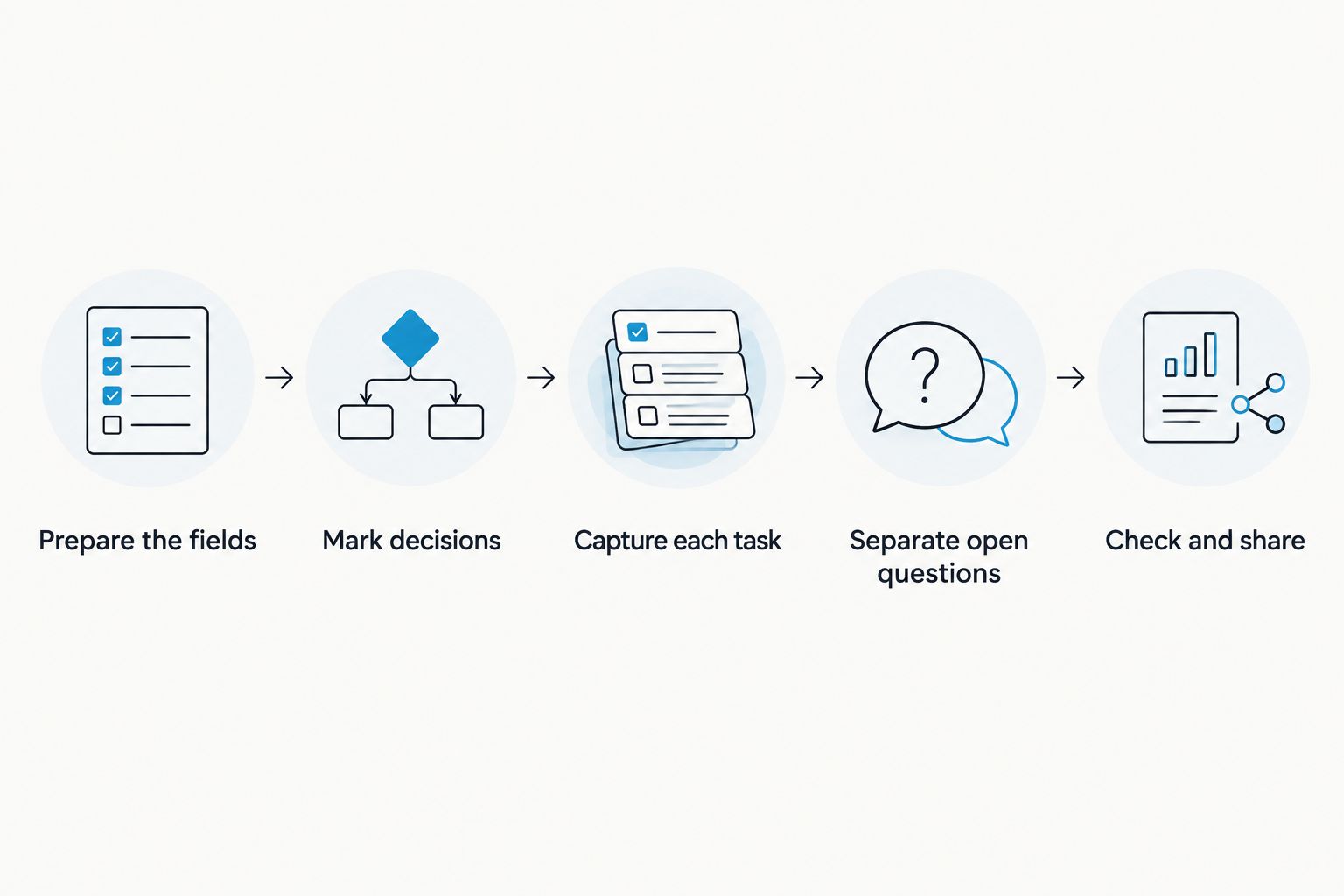
The check is the step that protects the rest. If a task sounds clear in the room but has no owner in the notes, ask who owns it. If two people describe a decision differently, settle the wording before it becomes the version everyone reads.
What should a meeting minutes template include?
The fields depend on what the meeting produces, but the core stays the same: meeting details, decisions, actions and open questions. Add short discussion context only when it explains an outcome. For example, a decision with an outstanding approval needs that condition; an abandoned idea does not need a paragraph of history.
Meeting details identify the record. Give the meeting a name people will recognize, and include the date and attendees. If attendance matters to the decision, distinguish people who attended from people who were absent. Do not treat an absent person as having accepted an action merely because their name came up.
Decisions describe outcomes. Use direct wording: the team chose an approach, postponed a choice or requested more information. Do not write “approved” when the group only expressed a preference. If the result is conditional, put the condition beside the decision so it cannot be missed.
Actions describe work. A useful action has a task and a named owner. An agreed deadline makes the handoff clearer; when there is none, flag it as not set. Keep each action distinct so a reader does not have to untangle several assignments from one bullet.
Open questions protect accuracy. List what the group could not resolve and who will pursue an answer. Once a question has an answer, update the record or carry the answer into the next meeting’s minutes. Do not quietly turn an open question into a settled decision.
Why do meeting minutes vary between meetings?
Use the same core fields, then change the level of detail to match what happened:
- Purpose: A status update needs fewer decision details than a meeting held to choose a course of action.
- Decisions: Record the conditions and unresolved approvals behind a choice; leave out repetitive discussion.
- Action items: Expand the action section when the meeting assigns work to several people.
- Open questions: Give unanswered issues their own space when they affect the next step.
- Attendees: Note participation clearly when the record needs to show who heard a decision or accepted a task.
- Follow-up: Include the next check-in when the group agrees to one; otherwise, do not imply it is scheduled.
This is why a meeting minutes template is a starting point, not a script. Keep the headings that make decisions and responsibilities easy to find. Remove unused headings from the shared version if they make the record harder to scan.
Should you use a transcript to write meeting minutes?
Use a transcript to verify wording, not to replace the minutes. It helps you check whether a decision was final, who accepted an action or what question remained open. Then write a shorter record organized by outcomes. For a 2026 meeting, a transcript can be source material, but it does not establish that everyone agrees with your summary.
If you capture audio, tell participants what you are recording and why. Consent rules vary by location, so check local law before recording. For meetings involving patient information or other sensitive material, follow the applicable requirements for your setting rather than assuming a note-taking tool determines what is permitted.
Omi’s wearable and companion app can capture conversations and produce transcripts, summaries and tasks. Omi is best for professionals who want a record to check while drafting meeting minutes; it does not replace confirmation of decisions and owners. For an in-person discussion, review the output before turning it into the official record. That extra check matters when someone proposes an action but never accepts it.
How detailed should meeting minutes be?
Detailed enough to explain the outcome, not detailed enough to recreate the conversation. Write the decision, any condition that changes its meaning, the assigned work and what remains unanswered. If a sentence adds none of those, remove it.
A meeting that reaches no decision can still have useful minutes. Record that the decision remains open, state what information is missing and name the person responsible for the follow-up if one was assigned. That is clearer than dressing up discussion as progress.
Minutes can also distinguish between a proposed task and an assigned one. If someone says a report would be useful, that is discussion. If someone agrees to prepare the report, that is an action item. Use the wording of the record to preserve the difference.
When should you share meeting minutes?
Share them after you have checked unclear decisions, owners and deadlines. The right moment is when the record is accurate enough to use and the agreed work has not lost its context. Do not hold back the entire document to polish a sentence that does not affect an outcome.
When you ask participants to correct the minutes, make the request specific. Ask them to check the decisions and actions that involve them, especially ownership and dates. If a correction changes a decision, update the shared record rather than leaving conflicting versions in circulation.
For recurring meetings, carry unresolved questions and unfinished actions into the next record as items to check. Do not silently mark them complete. The 2026 template above leaves room for those follow-ups without turning the minutes into an ongoing transcript.
Can meeting minutes be informal?
Yes. An informal meeting minutes template can be a short list of decisions, actions and open questions, with the meeting name and date above it. The test is whether another person can understand what was agreed without asking you to reconstruct the conversation.
Use more structure when several topics or owners are involved. A table or separate headings makes an action easier to locate and prevents an open question from being mistaken for a decision. Use less structure when the meeting produced little to record; empty sections do not make minutes more reliable.
Do not confuse informal with unverified. Even a brief record needs accurate names, clear assignments and careful wording about decisions. In 2026, the same rule applies whether your first draft comes from handwritten notes, typed notes or a transcript.
FAQ
What is the easiest meeting minutes template to use?
Use a meeting minutes template with meeting details, decisions, action items and open questions. Add discussion context only when it explains an outcome.
Do meeting minutes need to include everything everyone said?
No. Meeting minutes should record outcomes and responsibilities, not reproduce the conversation. Use a transcript separately if you need to check exact wording.
What if nobody sets a deadline for an action item?
Write the action and its owner, then mark the deadline as not set. Do not create a date that the meeting did not agree to.
What if the group does not reach a decision?
Record the decision as open. Note what information is missing and who accepted any follow-up task.
Can you use a recording to prepare meeting minutes?
Yes, a recording can help you check a draft, but you still need to confirm decisions and owners. Consent rules vary by location, so check local law before recording.
Who should review meeting minutes before they are shared?
Ask the people involved to check any unclear decisions, action owners and deadlines. Correct the shared record when a substantive detail changes.
How do you write meeting minutes for an informal meeting?
Write the date and purpose, then list decisions, assigned actions and open questions. Keep the record short while making each next step clear.
One last thing
The most useful line in your 2026 meeting minutes might be “no decision made.” It tells the next reader not to act on an option that was only discussed. Pair it with the open question and its follow-up owner, and the meeting still produces a clear next step.