"Wait, did I already confirm that?"
You know the moment.
A client says "like we discussed last week..." and your mind goes blank.
Did you already confirm that? Did you even reply to them?
Meanwhile someone else is saying "like you told me on Tuesday..." and walking away with the deal.
They're not smarter than you. They just don't lose what was said.
The good news : it's an easy fix. A VP of Sales at Salesforce runs his client calls without a notepad and pulls every promise out afterwards.
Now picture that being you.
You walk into every meeting already knowing what everyone said last time. Every name. Every number. Every promise.
Every client feels like they're your only client.
Below I'll show you how. Zero changes to how you work today.
7 min read
The big win (or loss) comes from 3 changes in how you handle conversations.
- Change #1 : Stop using your brain as a hard drive. Give it a second brain that saves every word. People buy from people they trust. And they trust the person who remembers.
- Change #2 : Stop taking notes. Start paying attention to people. Every human being wants to feel heard and needed. Give them that, and they'll want you at every table.
- Change #3 : Stop carrying promises in your head. Everything you say you'll do gets written down for you, automatically. No dropped balls. No lying awake asking "did I ever do that?"
Do these and you'll get what everyone really wants:
- More money. Clients buy from people they trust, stay longer and send their friends. Trust turns into income.
- More status. You become the sharp one. The A-player who gets promoted, and the one people point to in the room.
- More respect. People notice who keeps their word. At work and at home.
- Deeper relationships. Clients, friends, your partner. Everyone feels it when someone actually remembers them.
- Better health. Less stress. Less burnout. You stop running 40 open loops in your head about clients, deadlines and your team, and you finally sleep through the night.
Put all 3 together and you become the most respected person in any room. The one people trust, follow and want to be around. That person never chases work. Money, deals and people chase them.
First: why listen to me?
Before I worked at Omi, I tried everything to keep up with my own life.
Notebooks. Voice memos. Notes apps. Fancy software. I even built mind maps of my conversations.
None of it stuck. Because my conversations don't happen in one place.
They happen at a client lunch. On a call. At my desk. On a job site. In the hallway. At dinner.
No notebook can follow you everywhere. Something you wear can.
Now I work at Omi, the AI wearable used by over 300,000 professionals. So yes, I'm biased.
But I'm also the guy who tried every other way first.
Trust me when I say this works.
(If you just want the tool, skip to the end. The 3 changes work either way.)
FIRST : Stop using your brain as a hard drive
"The mind is not a vessel to be filled, but a fire to be kindled."
Plutarch, in his essay on how to listen, almost 2,000 years ago
The problem:
Your brain was never built to store everything.
Right now it's trying to hold every client detail, every deadline, every "I'll get back to you," and what your kid needs for school on Thursday.
Scientists say it can only juggle about 4 things at once.
Everything past that either falls out, or sits in the background draining you.
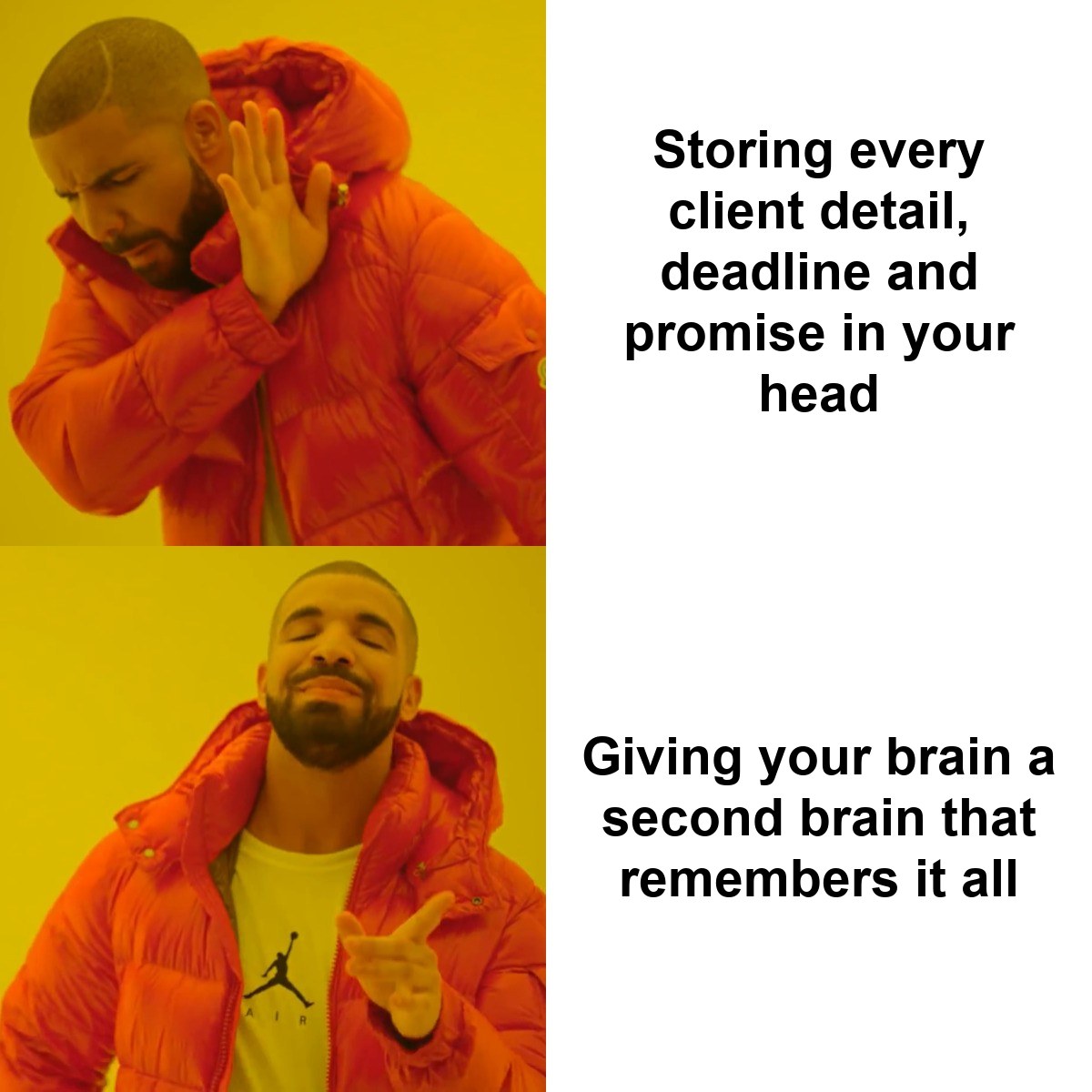
It's like a computer with 50 tabs open. Slow. Hot. Crashing at the worst time.
And the stuff that does get in doesn't stay.
Most of what someone tells you is gone by the next day.
Your brain is for thinking. Listening. Reading the room. Coming up with the big idea.
Productivity expert David Allen said it best: "Your mind is for having ideas, not holding them."
That's why you need a second brain. Something outside your head that holds every conversation, so your real brain doesn't have to.
Less to carry. More room to think. Fully present with the person in front of you.
And here's what nobody tells you.
The people you work with don't see your memory. They only see what you did with what they told you.
Forget it, and to them it looks like you didn't care.
Here's an example that makes or breaks a client:
You have lunch with a client. She tells you 3 things:
- Her budget gets approved on the 14th.
- Her last vendor "never followed up on anything."
- Her daughter just started college.
Three weeks later you're on the follow-up call. Here's how it goes:
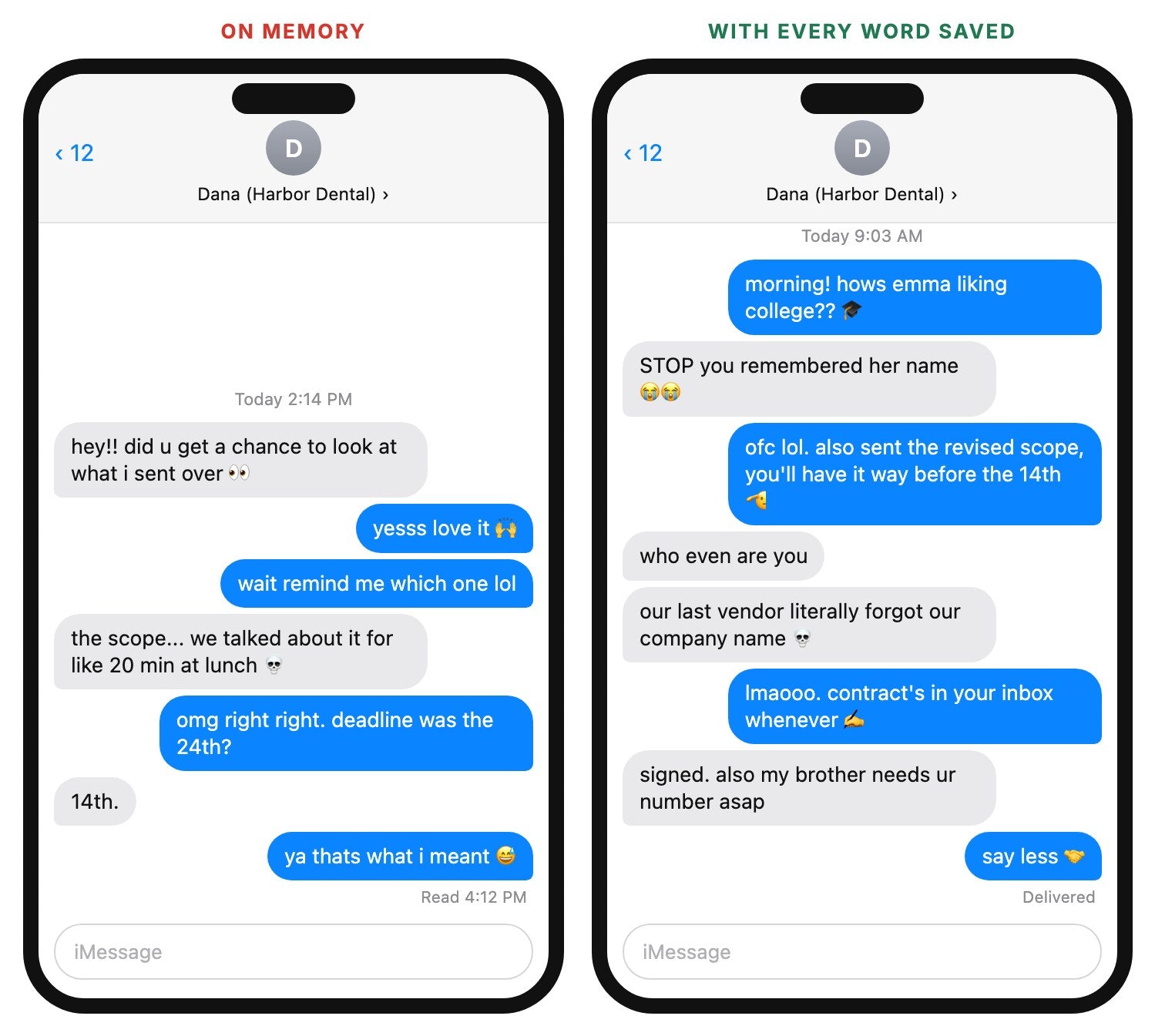
Same person. Same lunch. Same good intentions.
One sounds like the last vendor. The other one gets the deal.
And the deal isn't the end of it. She tells her friends about the person who "actually listens." That's how referrals happen.
Think about what just happened.
You didn't work harder. You didn't sell harder.
You just remembered.
That one thing made her feel like your only client. And people pay, stay and send their friends when they feel like that.
Fixing this is the easiest win you'll ever get.
The people who seem to remember everything aren't smarter than you.
They gave their brain a second brain.
THEN once every word is saved, make these 2 changes:
Big Change #2: Stop taking notes. Start paying attention to people.
Most people "fix" bad memory with a notebook or their phone.
It makes things worse.
You can't write and look someone in the eye at the same time.
And people can tell when you're writing instead of listening.
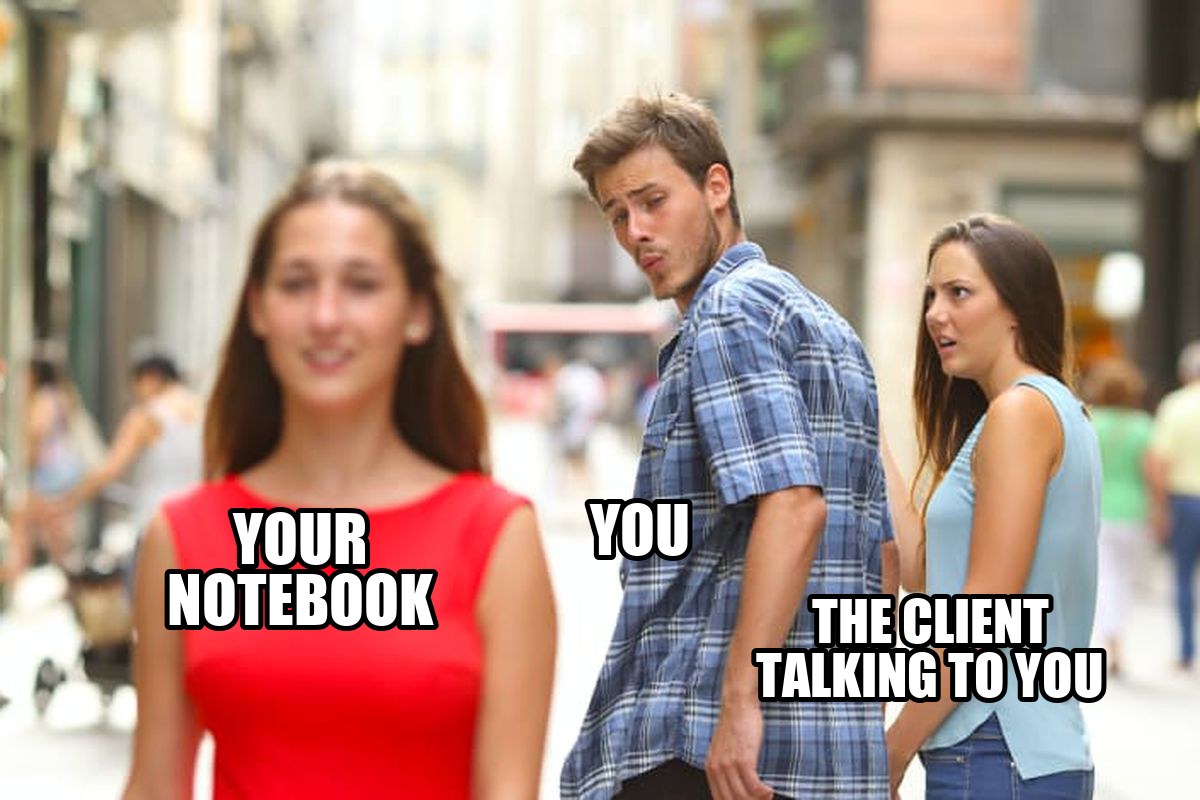
Every person you meet wants the same thing: to feel heard and needed.
And here's the other side of it.
Confidence doesn't come from a pep talk. It comes from knowing your stuff.
When you know exactly what was said, what was promised and what the client cares about, you answer without blinking. You quote the right number. You deliver exactly what they asked for.
That's real confidence. Not faking it. Having the context.
Now flip it.
You're on the call. They ask about something from last week. Your mind goes blank.
You stall. "Let me circle back on that."
Your face gets hot. They notice.
That feeling is shame. And clients can smell it.
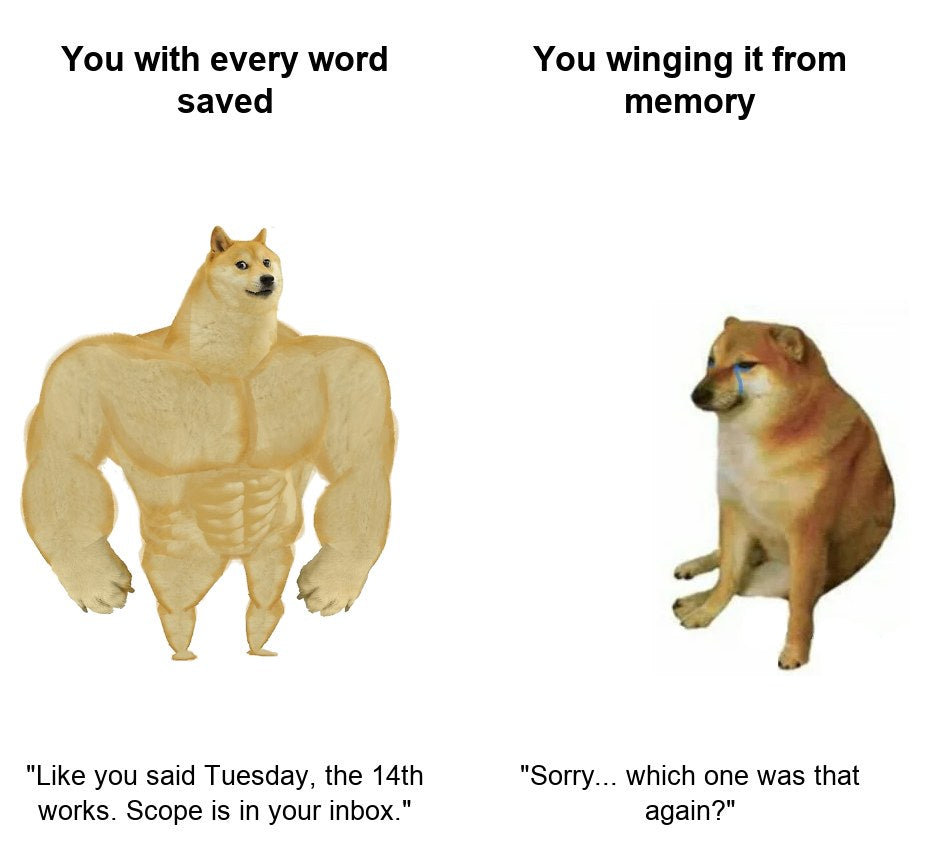
Clients buy from the one who knows. Bosses promote the one who delivers.
And you can't know what your brain already threw out.
Big Change #3: Stop carrying promises in your head
Every day you make little promises.
"I'll send that over." "Let me check and get back to you." "I'll pick him up at 5."
Each one is small. Drop one, and someone stops counting on you.
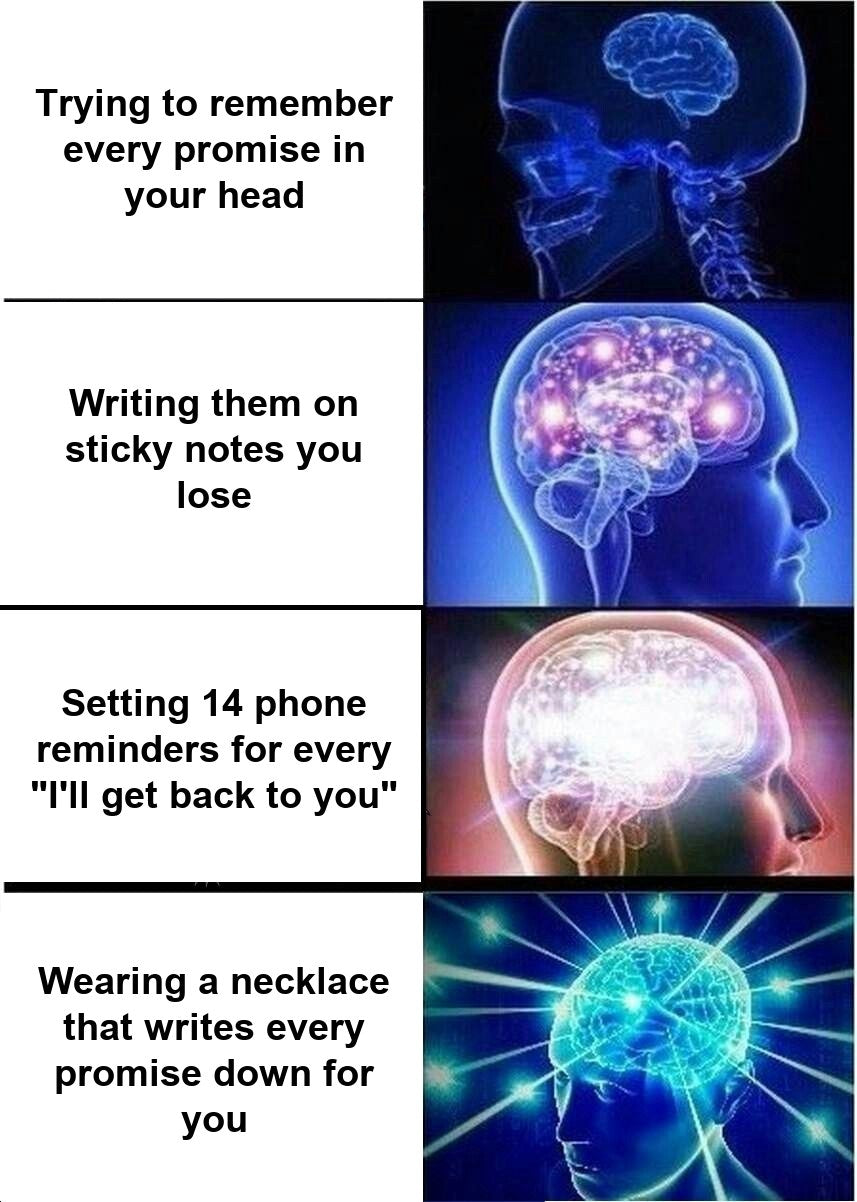
Step 1: Never carry a promise in your head.
Think about how many promises you make in a single day.
"I'll send that over." "Let me check with my team." "I'll call you Thursday." "Sure, I'll grab milk."
More than you'd guess. And every one is an open loop your brain has to keep running in the background.
With a second brain, the moment you say it, it gets written down for you.
You don't open an app. You don't type a thing.
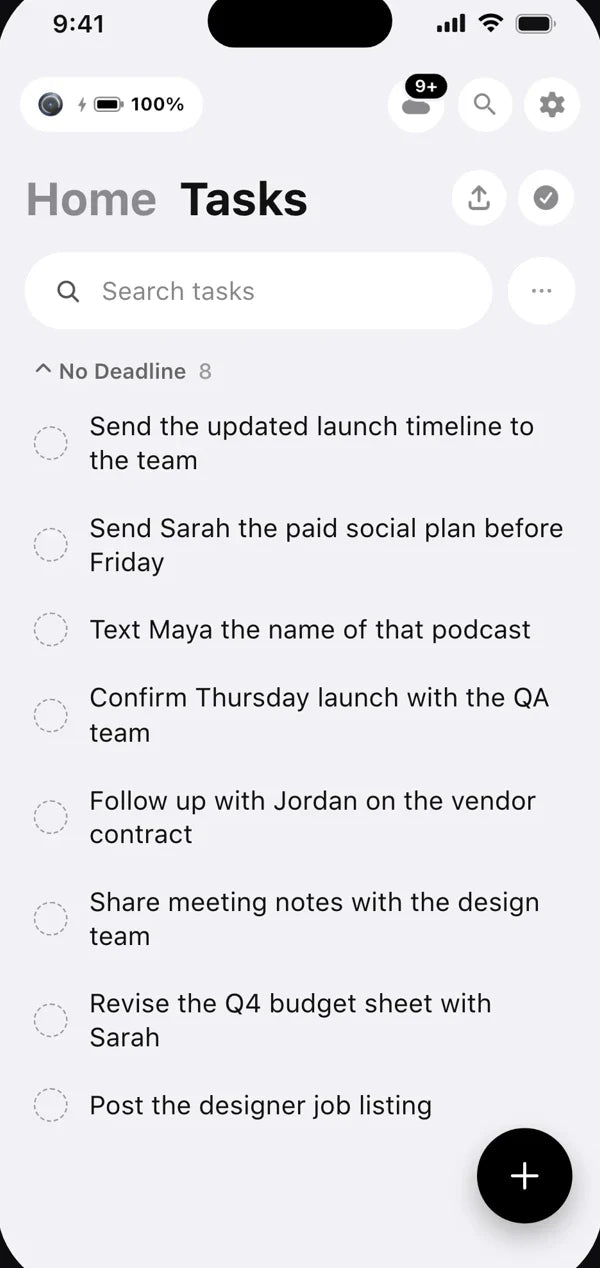
At the end of the day you look at one list.
Not your memory. Not six sticky notes. Not a voice memo you'll never play.
One list of exactly what you told people you'd do.
Nothing you promised can slip, because it never had to live in your head.
Step 2: Clear the list, then switch off.
Every client, boss and partner is quietly asking one question about you:
"Can I count on this person?"
They never say it out loud. But they're keeping score.
Every kept promise is a yes. Every dropped one is a no.
And once it's a no, it's very hard to turn back into a yes.
When your list is clear by Friday, the answer is always yes.
Picture Friday night.
Every promise you made this week: done.
No 2 AM "wait, did I ever send that?"
Phone down. You're actually at dinner with your family. Fully there.
That's what being dependable feels like from the inside.
But this still doesn't cut it
You could try all 3 changes with voice memos and a very good notes habit.
Here's why that falls apart:
- You have to remember to hit record. Every single time.
- Your phone sits on the table, and everyone sees it.
- A call or a notification cuts it off.
- Nobody goes back and listens to 40 minutes of audio.
A system you have to remember to use is just another thing to forget.
What I actually use instead
I wear a small pendant called Omi.
I put it on in the morning and forget about it.
It picks up my conversations wherever they happen. Across the table at lunch. On a job site. On a call. At my computer.
One second brain for every conversation. In person and online.
 Hears every word
2 to 3 day battery
Phone stays in your pocket
 On a chain
 On your wrist
Here's what it changes for me:
1. I have the full transcript. Every word.
Every conversation is saved, word for word, with a clean summary on top.
Who said what. What we decided. What matters.
I don't dig through notes. I don't try to remember. I open it and I know exactly what each conversation was about.
And it's mine to use. I hand it straight to my own AI, like ChatGPT or Claude, to write the follow-up, prep the next meeting or draft the proposal. My AI finally knows what actually happened.
2. I can talk to it.
I just ask. Like asking an assistant who was in the room with me.
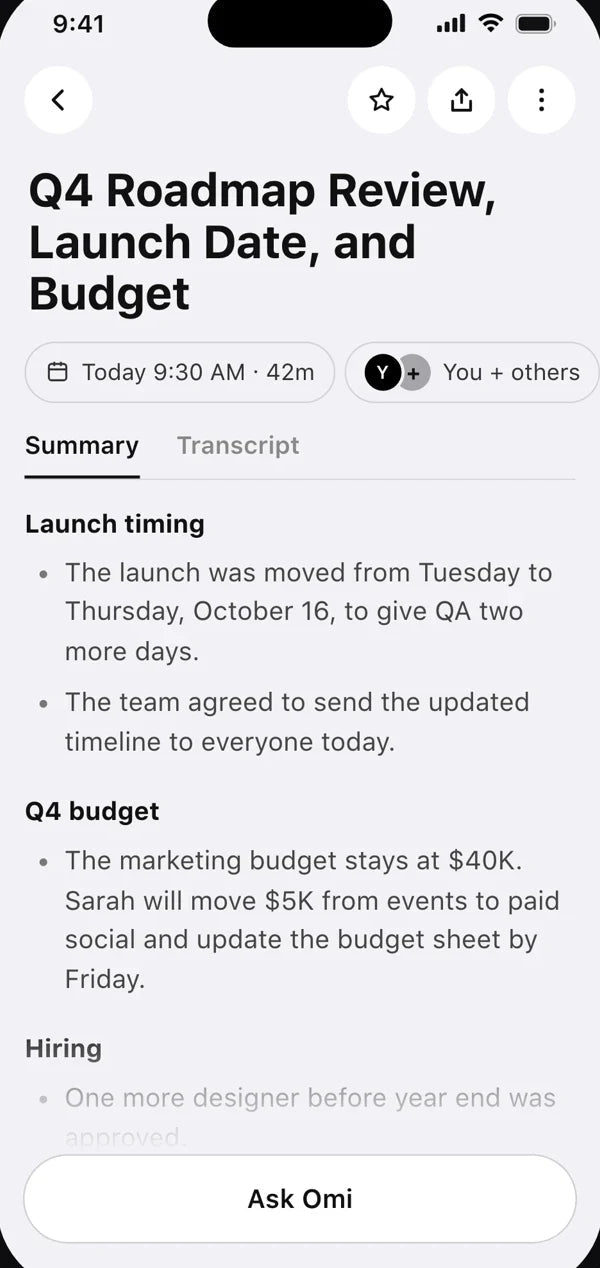
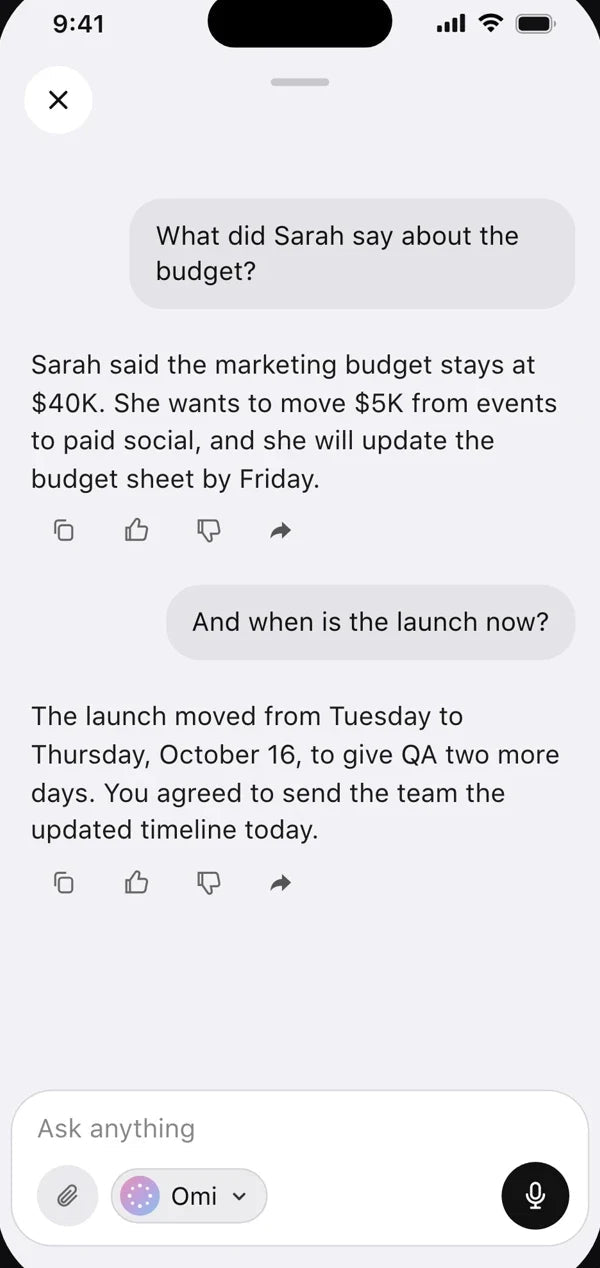
Before any follow-up: "What did Sarah say about the budget?"
Ten seconds later I know the number, what changed, and what I promised to send.
I open the call with that.
She doesn't think "this guy has a great tool."
She thinks "this guy actually listens to me."
3. I always deliver on my promises.
My to-dos are created the moment I say them out loud.
No writing them down. No going back through my notes at 9 PM.
I know exactly what I owe, and who I owe it to.
Not luck. Not a great memory. Just every word saved, and every promise on a list.
"But isn't it weird to record people?"
That was my first worry too. Here's what changed my mind:
- It's for your memory, not for spying. It does what a notebook does, without you staring at a notebook.
- Your data stays yours. Export or delete anything, anytime. You can even run it locally if you want.
- Nothing is hidden. Omi is open source, so anyone can check exactly how it handles your data.
- Serious security. SOC 2 and HIPAA compliant, encrypted in transit and at rest. The same standards hospitals and big companies ask for.
And the simplest fix of all: just tell people.
"Heads up, I wear a little AI that helps me remember what we talk about."
In my experience, people are more curious than bothered. Most of them ask where to get one.
(Recording rules differ by state and country, and some places need everyone's OK. Check yours. Telling people covers you either way.)
We've done 95% of the work. Here's what people who wear it say:
Runs client calls without a notepad and pulls the commitments out afterwards.
Wears it through back-to-back calls and reviews the summaries afterwards instead of taking notes.
Uses captured conversations as a working memory he can question later in plain language.
The Easy Way To Do All Of This
Whether you use Omi or not, from now on you must:
- Give your brain a second brain that saves every word.
- Stop taking notes in the room.
- Stop carrying promises in your head.
You can try to do it yourself with voice memos, sticky notes and a lot of discipline.
Or you can put Omi on tomorrow morning and never think about it again.
Think about the next 30 days.
Every client lunch. Every "let me get back to you." Every small thing someone trusted you with.
AI is making everyone around you sharper. You can fall behind, or you can be the one who remembers everything.
The people who get the deal, the raise and the second chance won't be the smartest ones in the room. They'll be the ones who remembered.
Here's the deal:
- $50 off right now. Omi is $129 instead of $179, for a limited time.Black Friday: $70 off. Omi is $109 instead of $179, through Monday night.
- Everything in the box. Chain, wrist band and charger. Wear it however you like.
- 30-day guarantee. Try it on your real meetings. If it's not for you, just message our support team and we'll walk you through the return.
That's all!
Jan
P.S. If you skipped to the end, here's the whole thing in four lines. AI won't take your job. The person who remembers everything will. Omi is a small wearable that saves every conversation, writes down every promise, and lets you ask it anything you heard. People trust, pay and promote the one who remembers. Be that person.
P.P.S. The $50 off won't last,Black Friday pricing ends Monday night, and you have 30 days to try it. Worst case, you message support and we walk you through the return. Best case, you never blank on a client again. Grab yours here.